Craftsmanship, innovation and human power
When we look at a hammock, we often think about the weaving.
The repeated gestures, the mesh, the pattern.
We imagine the artisan working with ready-made threads.
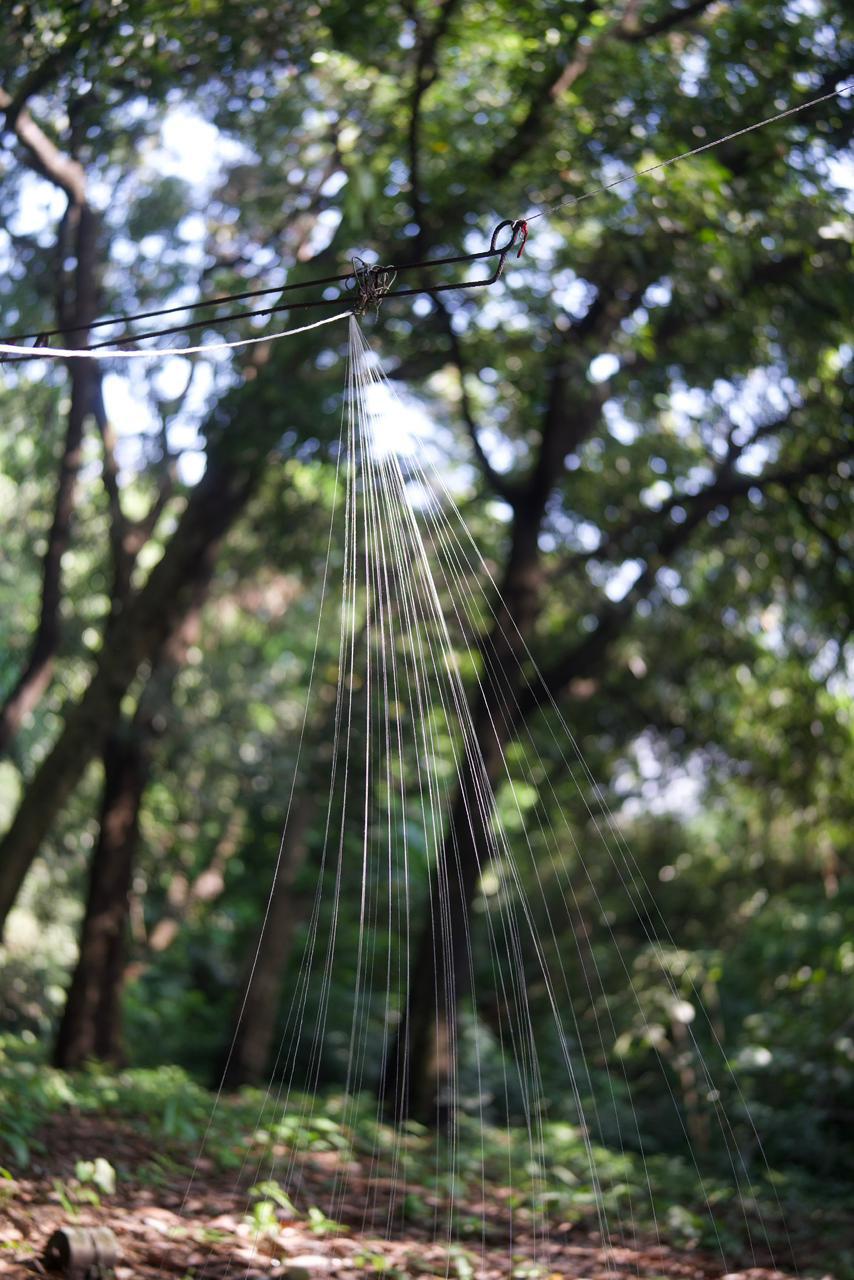
The reality is quite different. Even before weaving begins, there is an invisible, essential, and rarely explained step: the making of the thread itself.
Before weaving, there is the thread
In the Maya craftsmanship of Guatemala’s Pacific coast, cotton is not used as-is.
It is transformed, stretched, and assembled.
To obtain a thread capable of supporting weight, tension and time, artisans perform a key step: plying.
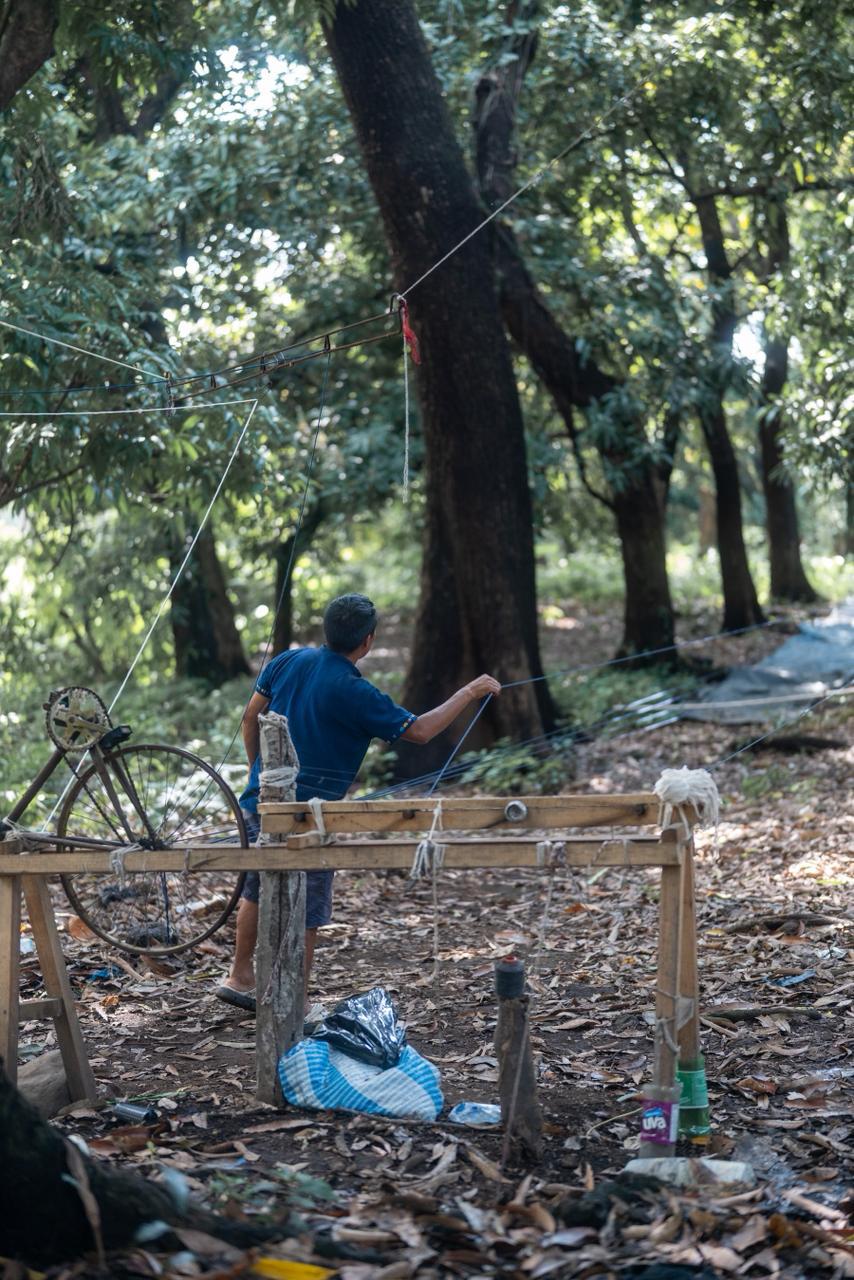
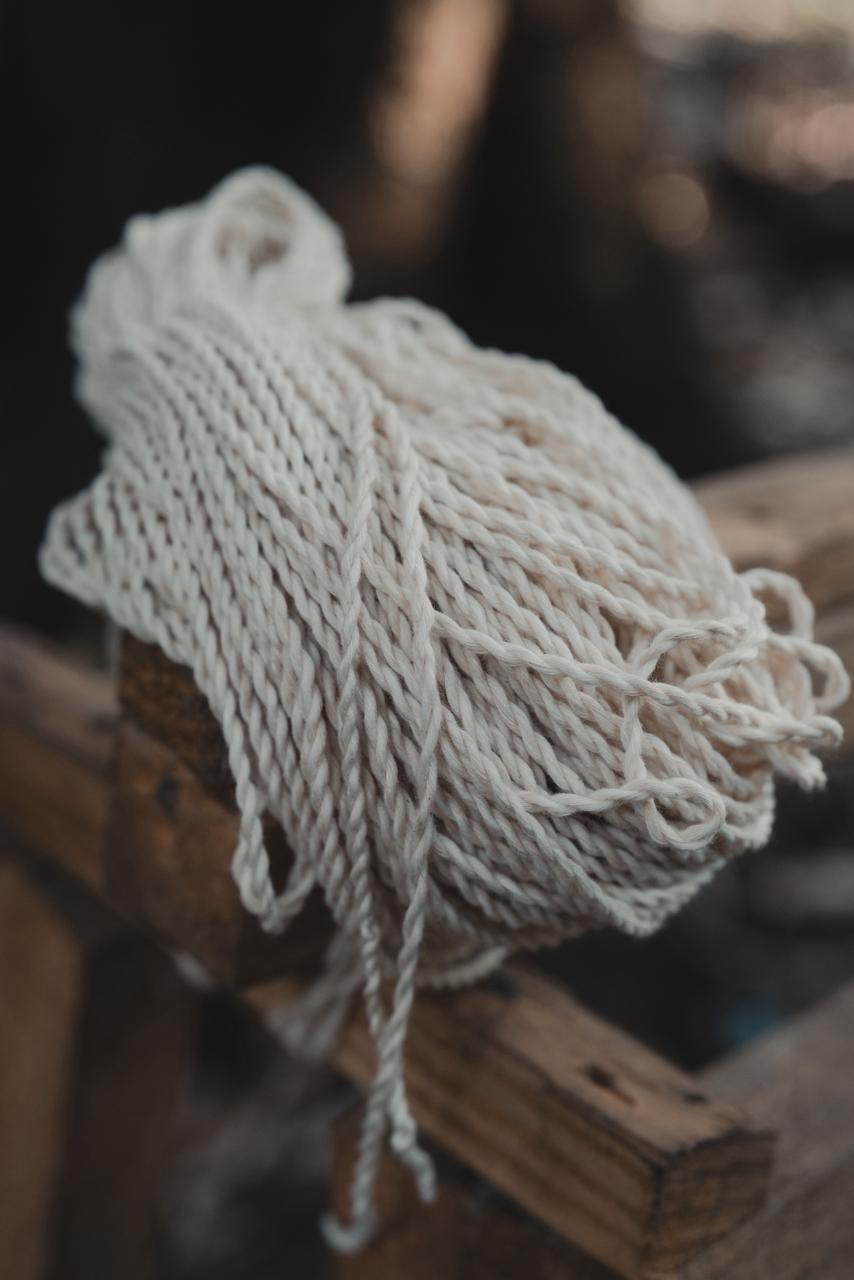
In practice, several fine threads are twisted together in a direction opposite to the original spinning.
This gesture creates a thicker, more flexible and more resistant thread.
This is the step that gives the hammock:
- its flexibility
- its ability to adapt to the body
- its long-term durability
Without this intermediate work, the hammock would be rigid, brittle or fragile.
A physical, demanding… and often overlooked step
This phase requires:
- long distances to stretch the threads
- constant tension
- great precision
- significant physical effort
It is a step that customers rarely think about.
They imagine an artisan working directly with finished thread.
Yet this is where much of the final quality is determined.
A simple innovation: the pedal-powered machine
Rather than introducing an industrial machine, our artisans adopted a solution consistent with local craftsmanship.
The idea was simple: to use human power, circular motion, and mechanics that are easy to understand and repair.
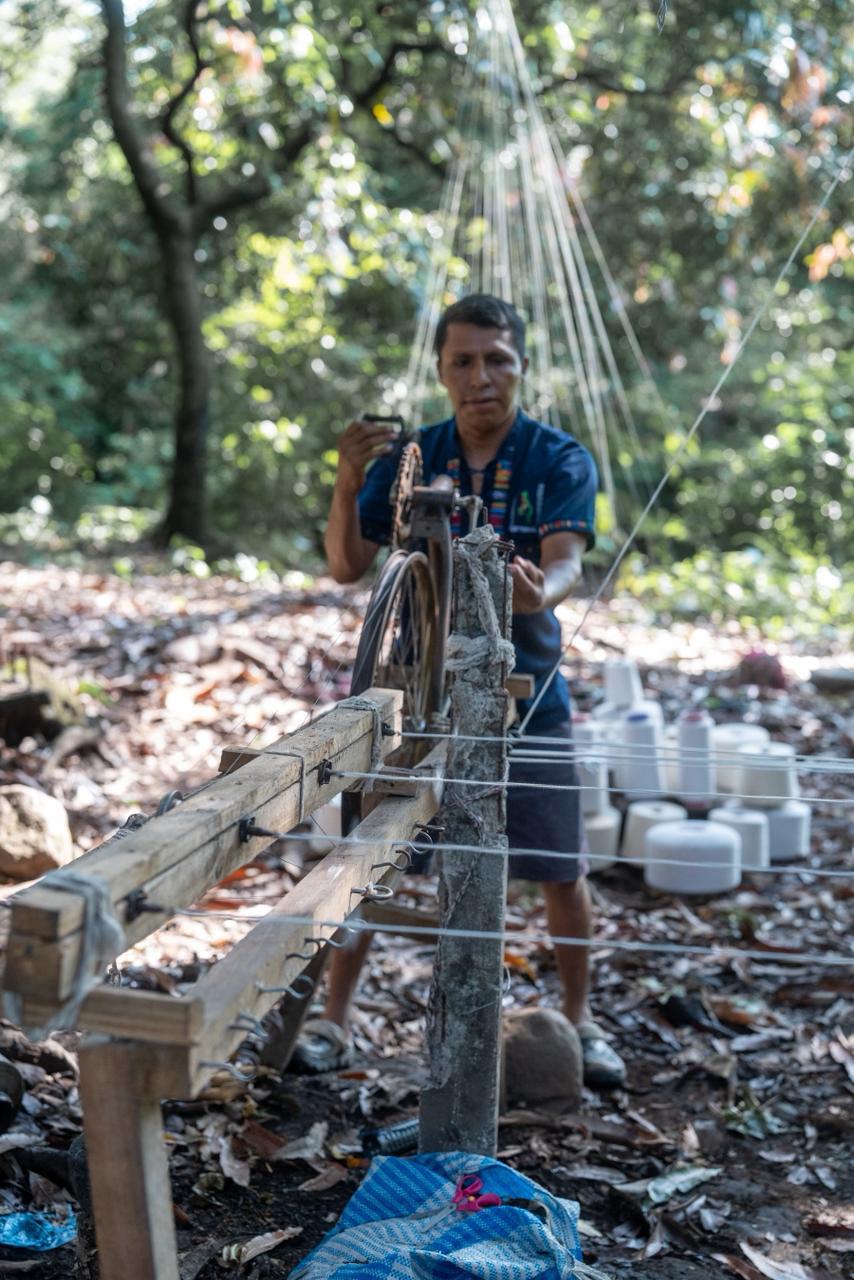
This is how a bicycle-powered machine was created, driven solely by human effort.
No motor.
No electricity.
Locally repairable.
Adapted to the artisan’s rhythm.
It allows for:
- more consistent tension
- less fatigue
- better thread quality
- work that is more respectful of the body
Here, innovation does not replace know-how.
It supports it.
Alfonso, artisan and guardian of the gesture
Alfonso is the main artisan we have been working with for many years.

He is the one who carries out this essential step, often in the shade of the trees, where there is enough space to stretch the threads over long distances.
This phase requires space.
That is also why we were able to help him acquire the land on which he works today.
Not to industrialize.
But to preserve a know-how under the right conditions.
After the thread: double-loop weaving
Once the thread is ready, weaving begins.
Depending on the region, techniques vary.
In the Yucatán, for example, a double-loop weave is used, made with a shuttle.
Each region, each artisan, brings their own signature.
The hammock then becomes a cultural object, far more than a simple accessory.
Restoring value to what is invisible
A hammock is not just an object for rest.
It is the result of a succession of invisible, precise and deeply human gestures.
Understanding these steps also means buying differently.
With greater awareness.
And with greater respect for those who make them. — Mayan Dreams